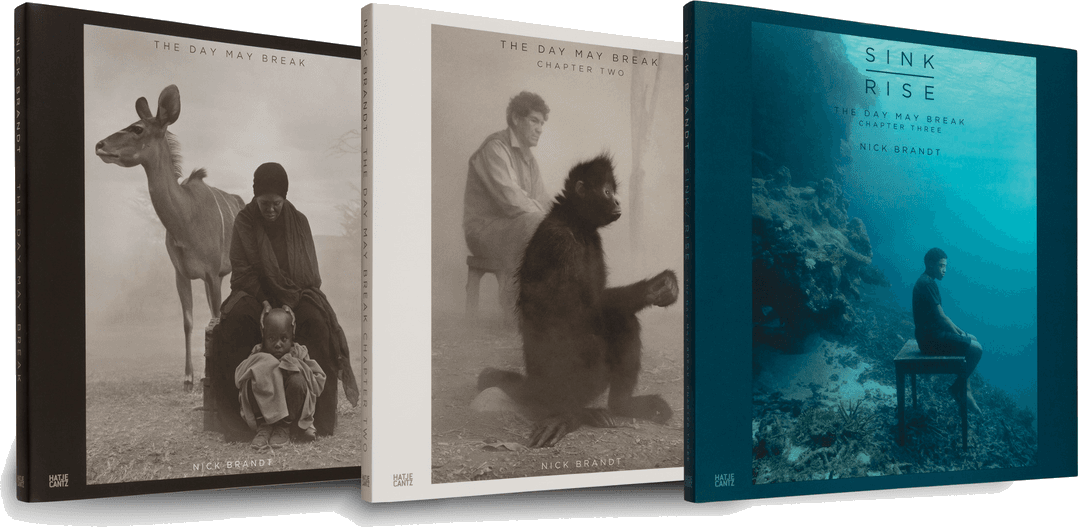
Cover courtesy of Hatje Cantz
Photography shelf · Boxed
The Day May Break: Chapters One, Two, and Three
Nick Brandt
Photographs by Nick Brandt, Zoë Lescaze, Nadine Barth
Three large-format hardback volumes, each roughly 310–330mm square, issued in a slipcase box. The square format gives Brandt's wide compositions room across the spread. Paper quality and print reproduction are central to the project: the fog work in Chapters One and Two depends on subtle tonal gradation, and the underwater photography of Chapter Three on precise colour rendering. At approximately 1.36kg per volume, the set occupies the large-format object category without ambiguity.
- Publisher
- Hatje Cantz (2024)
- Pages
- 432 pages
- Size
- 33 × 33 cm
- Binding
- Boxed set
- ISBN-13
- 9783775757331
Three volumes of large-format photography that place the human and animal costs of climate change in the same frame, built with unusual methodological rigour and issued as a properly substantial physical object.
The editors' view
Nick Brandt began this series in late 2020, photographing in Zimbabwe and Kenya. The concept is precise: people displaced by climate-driven floods and droughts, and rescued animals that cannot be returned to the wild, brought together in a single large-format frame. Industrial fog machines deployed on location unify each image in a shared atmosphere. The fog reads simultaneously as environmental metaphor and as the smoke from wildfires that has become a fixture of the contemporary landscape.
Chapter Two moved to Bolivia, to the Senda Verde wildlife sanctuary, where Brandt continued the same approach in 2022. Chapter Three, titled SINK/RISE, marks the sharpest formal break: Brandt photographed South Pacific Islanders underwater, off the coast of Vanua Levu, Fiji, in 2023. He shot entirely in-camera, using a 4×4-metre silk frame at the surface to manage the light. Subjects hold their breath, seated at tables or standing on chairs on the ocean floor. The coral around them was already bleached and broken. This chapter introduces colour for the first time in the series: a muted blue-green that reads as disturbance rather than beauty.
The boxed set gathers all three volumes under one cover. Each runs to square format at roughly 310–330mm, substantial enough to hold a double-page spread without compression. Text from Zoë Lescaze, Yvonne Adhiambo Owuor, Percival Everett and Daniel Sherrell provides context across ecological and political registers. Brandt co-founded Big Life Foundation in 2010, an organisation employing more than 300 local rangers protecting 1.6 million acres of the Amboseli–Kilimanjaro ecosystem. That fact is not incidental to the work; it is the condition of it.
Shelved alongside
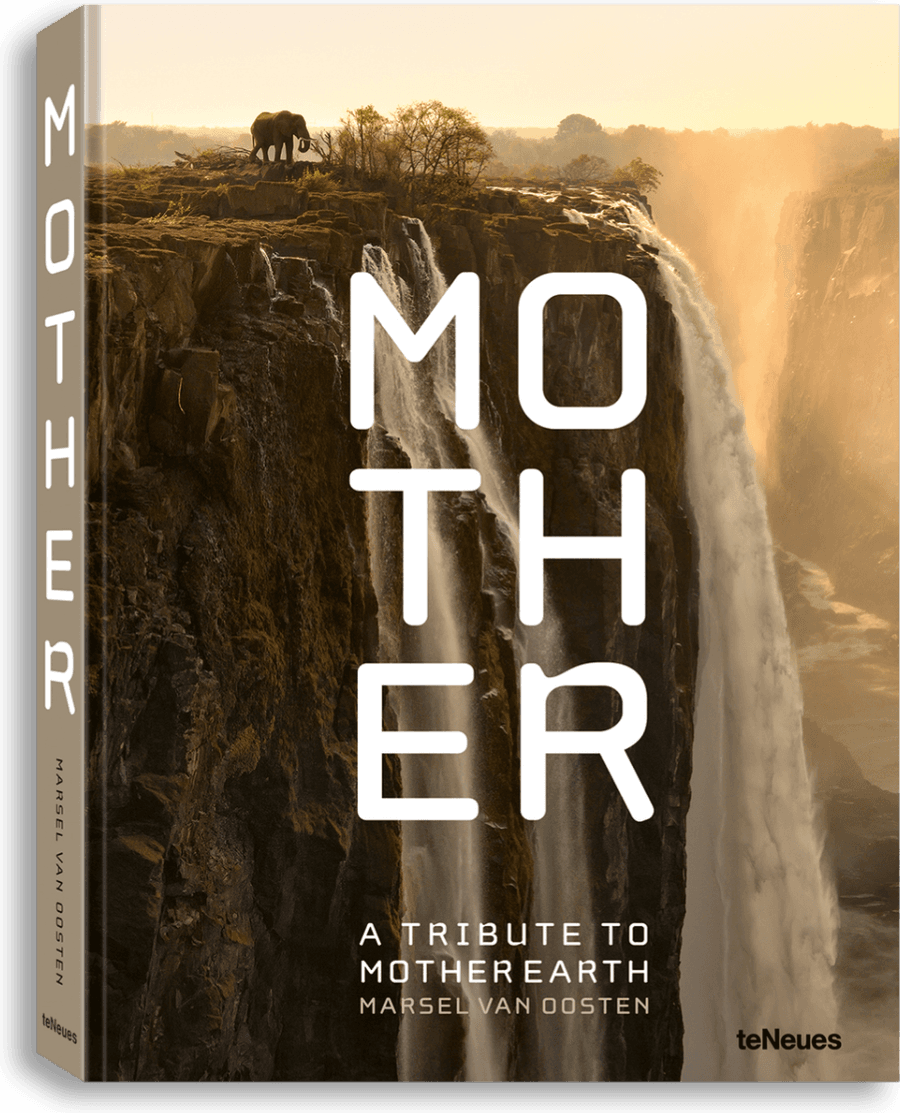
teNeues · Photography
Mother: A Tribute to Mother Earth
Marsel van Oosten
Van Oosten works at the scale of a single subject: one elephant, one waterfall, one tree. In a 270 x 360mm format, printed by teNeues, that turns out to be quite enough.
320 pages36 × 27 cm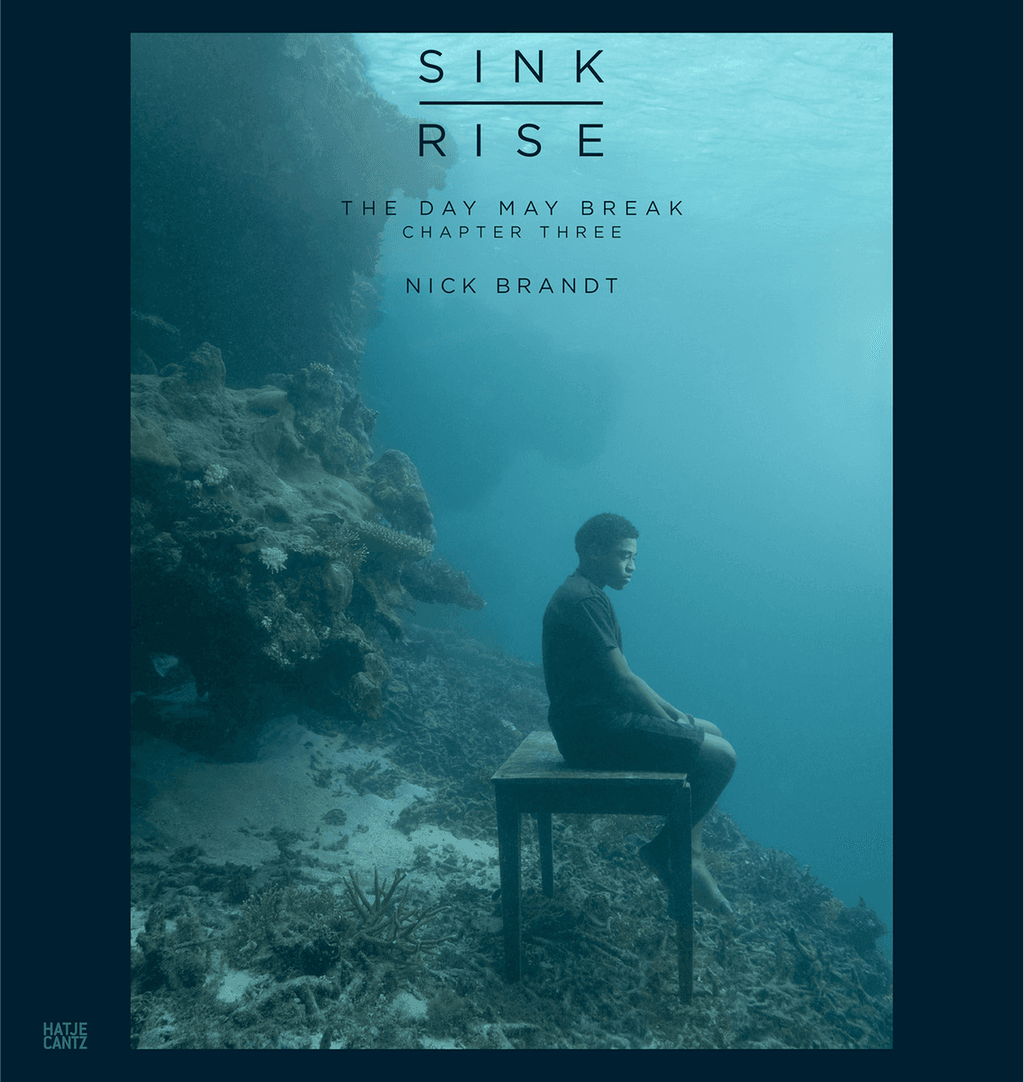
Hatje Cantz · Photography
SINK / RISE: The Day May Break, Chapter Three
Nick Brandt, Zoë Lescaze and 1 other
The photographs in this book should not exist. Nick Brandt somehow made them anyway, entirely in-camera, on the ocean floor off Fiji.
120 pages32 × 31 cm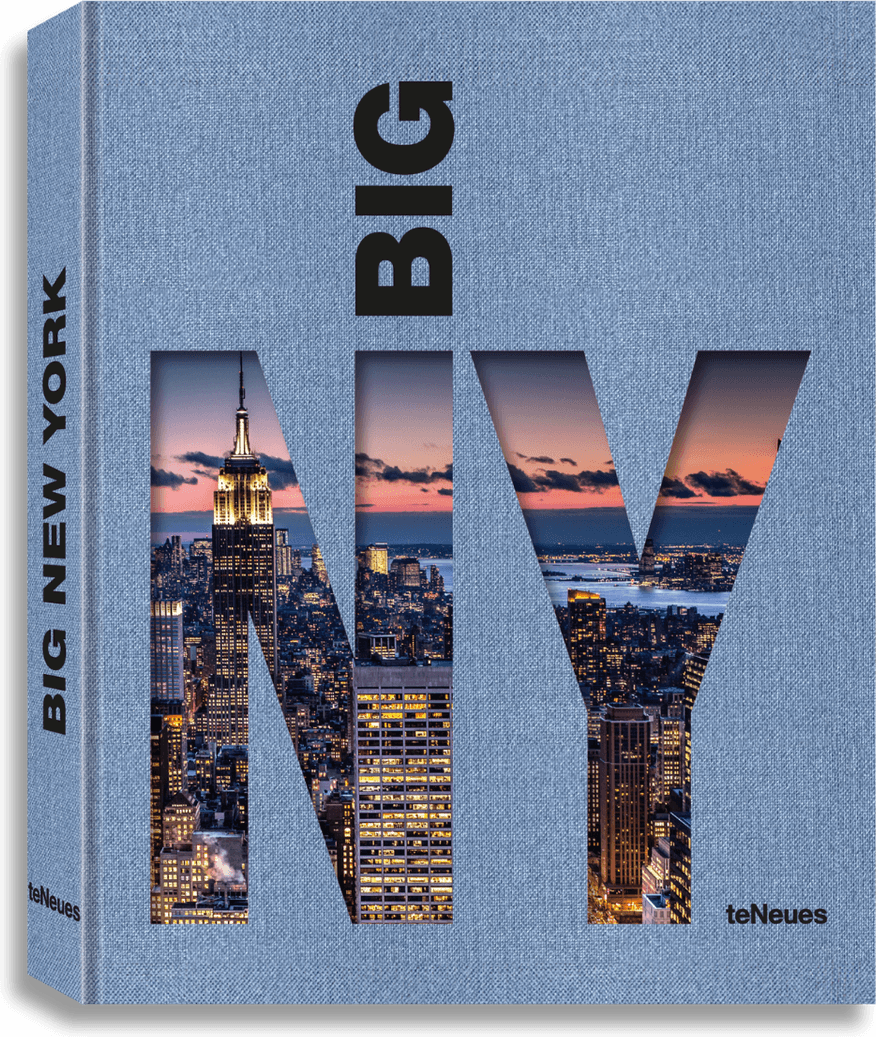
teNeues · Photography
Big New York
Elliott Erwitt, Thomas Hoepker and 5 others
Seven decades of New York, fourteen photographers, one XXL slipcase. The range is the point.
512 pages37 × 29 cm
Aperture · Photography
I'm So Happy You Are Here: Japanese Women Photographers from the 1950s to Now
Pauline Vermare, Lesley A. Martin and 5 others
The most comprehensive English-language survey of Japanese women's photography to date, and unusual for a picture book in having the scholarly translations to support that claim.
440 pages28 × 21 cm